
Framingham Wood Flooring refinishes and builds hardwood stairs in Framingham, MA, serving surrounding cities including Cochituate, Marlborough, Hopkinton, Wellesley and Maynard. With more than 20 years on wood floors and stairs, we sand treads by hand, replace worn or carpeted steps with new hardwood, and match the stairs to the floors at the top and bottom so the whole house reads as one finished space.
Stairs take more wear than almost any other floor in a home, and they are the first thing many visitors see. They are also the hardest part of a floor project to do well, because every tread, nosing and riser has to be worked individually. That is why we price stairs by the tread and riser rather than folding them into a square-foot floor price, so you can see what the stairs actually cost.
Whether you want to bring back worn oak treads, remove old carpet and reveal the wood beneath, or replace the steps entirely, we start by looking at what is there now. The answer changes the scope, the schedule and the price, and it is better to know it before the job starts than halfway through it.
Refinishing Existing Stairs
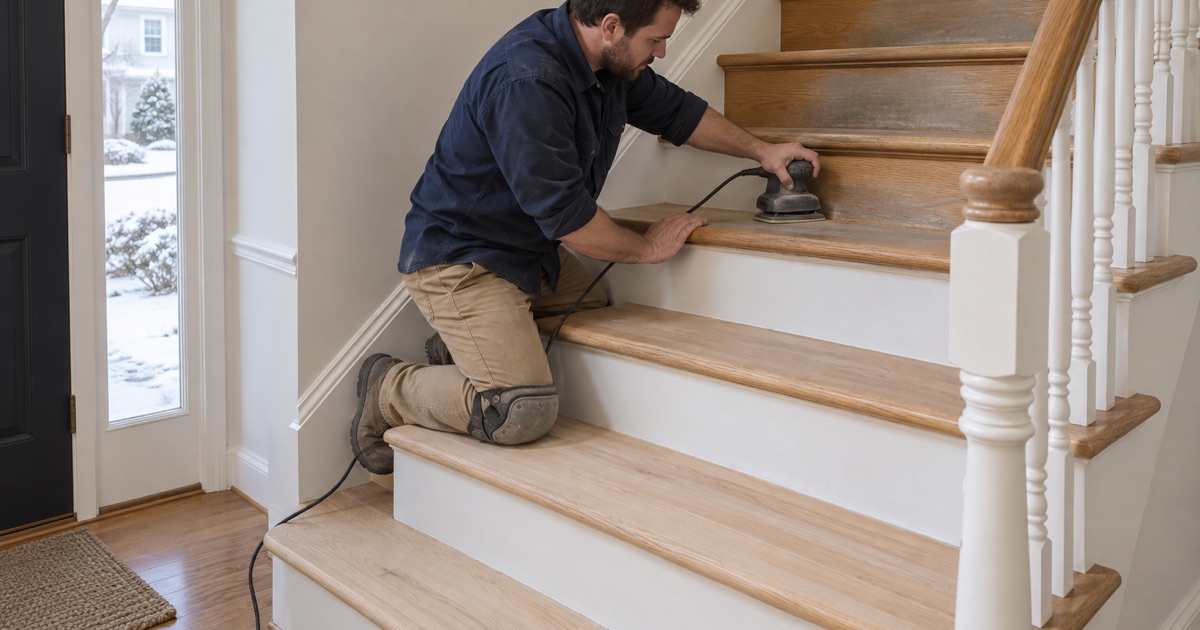
Sanding Stair Treads by Hand
A drum sander cannot reach stair treads, so each step is sanded with small hand-held sanders and scrapers, working into the corners and along the nosing. We take each tread through the same grit sequence as the floor, so the finish looks consistent from the top step to the bottom. The work is slow, but rushing it leaves swirl marks and uneven color that stand out on stairs more than anywhere else, because the light falls across them at an angle.
Painted Risers and Older Houses
Many staircases have painted risers, stringers and balusters, and in houses built before 1978 that paint may contain lead. Massachusetts runs its own lead-safe renovation rules for that housing, and sanding painted surfaces is exactly the kind of work they cover. We check the build year and the painted parts before starting, and plan the job so painted areas are handled correctly rather than sanded into dust that spreads through the house.
Matching the Stair Color to the Floors
Stairs usually connect two floors, and they need to match both. We choose stain and finish for the stairs at the same time as the floors, testing samples on a tread and on the floor so the colors line up. Stair treads are often a different species or cut from the floors they join, so the same stain can look different on each, and testing first prevents a mismatch at the landing.
Converting Carpeted Stairs to Hardwood
Removing Carpet, Pad and Tack Strip
Carpeted stairs hide a lot of fasteners: carpet staples on every tread and riser, tack strip at the back of each step, and pad that may have stuck to the wood. We remove all of it and fill the holes before deciding whether the existing treads can be refinished. Leaving staples in place tears sanding paper and scars the wood, so this cleanup always comes first.
New Treads Over Rough Steps
If the treads under the carpet are rough construction lumber, they need to be replaced or capped with new hardwood treads. We measure every step individually, because old stairs are rarely square or even, and scribe each new tread to fit its own opening. Stair treads come in red oak, white oak and other species, and we match them to your floors so the stairs and hallway look like one continuous surface.
Replacing or Refacing Risers
Risers can be replaced with new wood or painted panels depending on the look you want. A painted riser with a stained tread is a classic New England staircase, while wood risers give a warmer, more modern look. We fit the risers tightly under each tread and nosing so there are no gaps where dust and light show through.
Stair Parts and Details
Stair Nosing and Returns
The nosing is the rounded front edge of each tread, and on open staircases the tread also has a return where it turns along the side. These parts get the most wear and are the hardest to refinish or replace cleanly. We shape and fit nosing and returns by hand, matching the profile of the existing treads or the new ones, so the edges look crisp and hold up to years of feet.
Landings and Transitions to the Floor
Where the stairs meet a landing or a hallway floor, the nosing and floorboards have to line up and finish the same way. We plan the transition at the top and bottom of the stairs so there is no awkward step, gap or color change. Landings are often floored to match the adjoining floor and finished with the stairs in one sequence.
Safety, Sheen and Traction
Stairs are where a slippery finish can hurt someone. We usually recommend a satin or matte sheen, and some finishes can include a traction additive for households with small children, older adults or dogs. Runners fastened down the center are another option, keeping the wood visible along the sides while adding grip where people actually step.
How We Price Stairs
Per Tread and Per Riser
Every estimate lists stairs separately, priced by the tread and riser. Refinishing an existing tread, installing a new one and replacing a riser are each priced on their own, so you can compare options and choose which parts to refinish or replace. The number never hides inside a square-foot figure that makes a floor look cheaper than it is.
What Changes the Price
Open staircases with returns, winder steps that turn a corner, curved stairs and painted balusters all take more time than a straight, closed staircase. We note those details on the estimate so the price reflects the actual staircase in your house, not an average one.
- 20+ Years on Wood Floors
- Free Written Estimates
- Lead-Safe Work Practices